|
|
|
|
|
|
Subsurface ImagingAn acoustic system for high-resolution imaging of objects buried in soil has been developed. Our system uses many of the same techniques as medical ultrasound, however, on a very different medium. Our goal is to image cultural artifacts in order to assess, in a rapid, highly sampled manner, the historical significance of a potential construction site. In a preliminary study conducted at the Bioacoustics Research Laboratory, the acoustic propagation properties of six types of soil were evaluated. The soils were chosen to represent a range of organic matter, sand, silt, and clay, and particle size, and they were investigated for varying moisture levels and compaction. The attenuation coefficient in the 1-10 kHz range varied approximately linearly with frequency, and the normalized attenuation coefficient ranged between 0.1 and 1.0 dB/cm-kHz with a mean of approximately 0.5 dB/cm-kHz. The propagation speed ranged from 80 to 250 m/s with values typically between 100 and 200 m/s. These values are in agreement with values predicted by the Biot theory for sound propagation is porous media.
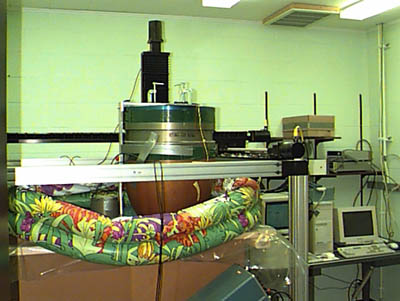
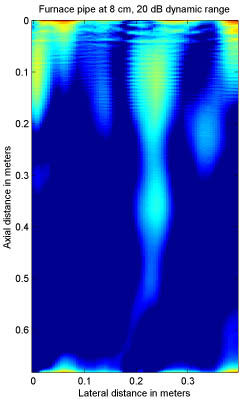
We have built the imaging system, which incorporates a single element source transducer and a receiver array, both obtained from the Applied Research Laboratory at Penn State University. The source and receiver array are moved together along a linear path to collect data to form a B-mode image. The source is well approximated as a point source. The transmitted signal is a cosine weighted pulse of 5 cycles at a center frequency of 6 kHz. A 52-element sonar array (8x8, 3.56 cm^2 close-packed elements with 3 elements missing from each corner) acts as the receiver and allows for beamforming on receive, which is accomplished off-line using delay-and-sum beamforming. This system is in operation at the U.S. Army Construction Engineering Research Laboratory (CERL) in Champaign, IL, where the data are collected in a controlled volume (120 x 120 x 60 cm) of dry sand. Using this system, we have obtained B-mode images of a flat steel plate (45 x 45 x 1.5 cm, buried 13.5 cm deep), an air-filled pipe (10 cm in diameter and 90 cm in length, buried 8.5 cm deep), and an aluminum bar (70 x 10.5 x 1 cm, buried 6 cm deep) next to an air-filled glass bottle (7 cm diameter, 11.5 cm deep, separated from the bar by 30 cm). The image of the air-filled pipe is shown.
Reference 1. Mamou, Jonathan, "Acoustic Subsurface Imaging," Master's Thesis, University of Illinois at Urbana-Champaign, 2002. PDF: Postscript: |
|
||||||||||||||||||||||||||||||||||||||||||||||||||||||||||||
|
| Bioacoustics Research Lab. |
|